

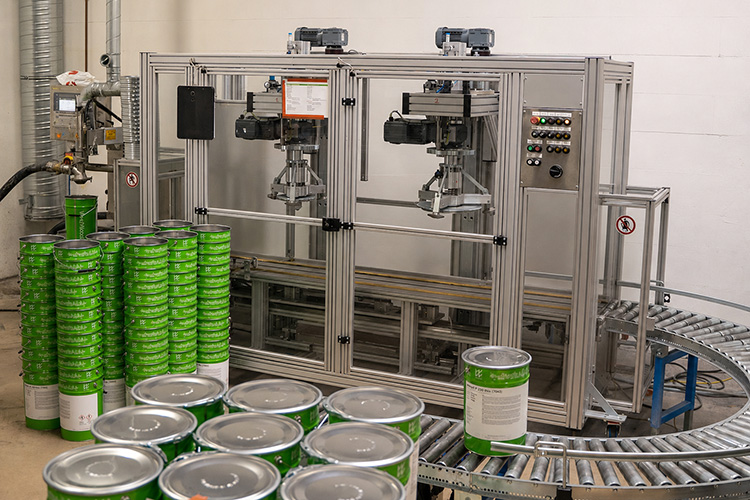
Filling systems for construction chemicals
Robust filling processes for construction chemical products
A wide range of products with consistencies ranging from liquid to pasty are processed and filled in the construction chemicals industry, including bitumen, primers, dispersions, additives, resin systems, and other construction chemical products. Depending on the application, these products can differ significantly in viscosity and flow behavior as well as in their container and safe-handling requirements.
In day-to-day production, filling systems must operate precisely and reliably, even under demanding conditions – including changing batches, different fill volumes, or varying containers. FRICKE develops filling systems tailored to product characteristics, containers, fill volumes, production environments, safety requirements, and the desired level of automation.
Typical requirements in the construction chemicals industry
- Precise filling of products ranging from liquid to pasty
- Reliable handling of demanding construction chemical products
- Flexible system concepts for different containers and fill volumes
- Stable processes when products or batches change
- Robust design for industrial production environments
- Integration into existing production and packaging processes
FRICKE solutions for construction chemicals
The focus is on the precise and robust filling of construction chemical products ranging from liquid to pasty. During system planning, FRICKE takes into account product behavior, viscosity, flow behavior, the intended containers and fill volumes, the production environment, safety requirements, and the desired level of automation.
This results in customized system concepts – ranging from robust single-station solutions to automated filling lines – that can be integrated into existing production and packaging processes.
For applications involving solvent-based or other flammable construction chemical products, FRICKE filling systems can also be designed for use in potentially explosive atmospheres in accordance with ATEX Directive 2014/34/EU.
Our expertise



Experience from completed projects
FRICKE dosing and filling systems are used worldwide in various industries. Selected customer projects demonstrate how customized system designs can make production processes more precise, efficient, and reproducible.
Discover real-world examples and learn more about solutions implemented in various industries.

Frequently asked questions
Would you like to know which filling solution is right for your construction chemical product and production process?
Here, we answer frequently asked questions about construction chemicals, viscous and pasty products, containers, product changeovers, and integration into existing production processes.
FRICKE filling systems can be designed for a wide range of construction chemical products with consistencies ranging from liquid to pasty, including bitumen, primers, dispersions, additives, resin systems, and other construction chemicals. The specific solution depends on the product characteristics, viscosity, flow behavior, the intended containers and fill quantities, the production environment, safety requirements, and the desired level of automation.
Yes. Depending on the application, FRICKE filling systems can be configured for products ranging from low-viscosity liquids to pasty products. The appropriate design depends, among other things, on the product properties, viscosity, flow characteristics, the intended containers and fill volumes, the production environment, and the desired filling process.
Yes. FRICKE filling systems can be designed for use in potentially explosive atmospheres, for example, when filling solvent-based or other flammable construction chemical products. Depending on the product, process environment, and zone classification, FRICKE takes into account the necessary explosion protection measures in accordance with EU Directive 2014/34/EU (ATEX). The specific design is based on the requirements of the respective application.
Technical information about system concepts, filling methods, containers, and automation options can be found on the Filling Technology page.